When I picked up this memoir, I didn't approach it by taking sides. Whether it is the story of someone belonging to the political or non-political world, or someone from any other walk of life, I want to understand their journey, their experiences and, most importantly, their perspective.
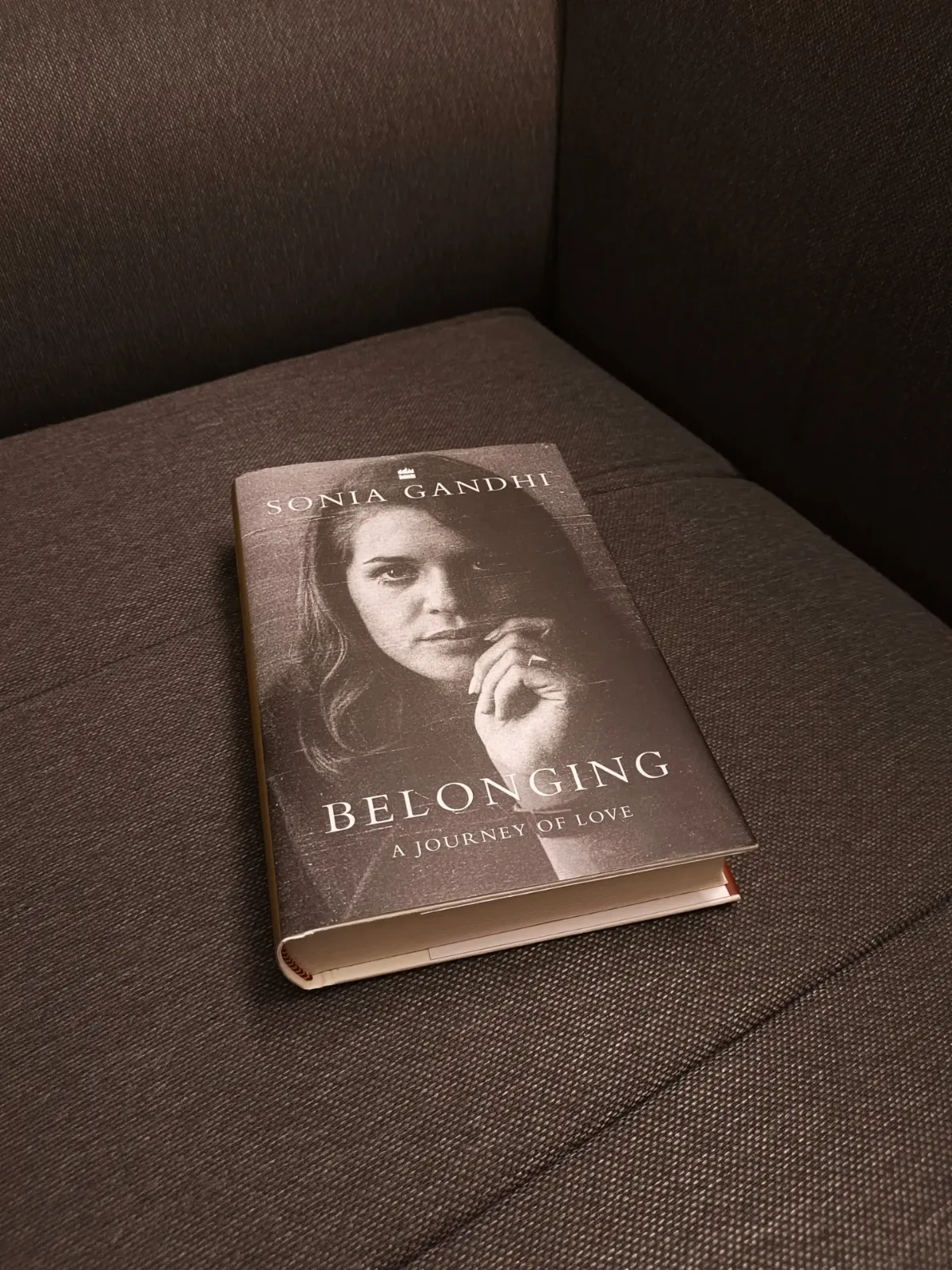
At the same time, I don't necessarily believe that everything written in a memoir is the absolute truth. A memoir is, after all, someone's recollection of their own life, shaped by their memories and personal experiences. And especially when a politician writes one, there is always the possibility that certain events and experiences are presented from a perspective that best suits their narrative. After all, everybody is a hero in their own story.
Finally published by HarperCollins, Belonging: A Journey of Love is a memoir that immediately draws attention, particularly given the political history associated with the Gandhi family. Political memoirs have a history of their own in our country, and Indian politics, with its vast, complicated and often critical landscape, has always been a subject of immense public interest.
The memoir is divided into seven parts, and the first part takes us back to 1965, to the story of a young girl from a small village in Italy who falls in love with a handsome and charming young man studying at Cambridge, England. This is where the story of Sonia Maino and Rajiv Gandhi begins. What unfolds is an account of love at first sight, courtship and a relationship that would eventually bring her to India, where she would become part of the Nehru-Gandhi family, a family deeply woven into the political history of independent India.
The first chapter of the book is probably one of the most beautiful parts of this memoir because it takes us into Sonia Gandhi's life before she became part of the Gandhi family. It introduces us to the young Sonia Maino, her childhood, her family, her upbringing and the circumstances that eventually brought her into the world of Gandhi's.
Sonia takes us back to her own family and her life in Italy in 1965.
These are interesting personal recollections, and they offer a perspective into the family dynamics of that period. However, I couldn't help feeling that the narrative places a considerable part of the responsibility on Sanjay Gandhi, while Indira Gandhi's own political accountability receives relatively less examination. Whatever the influence of Sanjay Gandhi might have been, it was Indira Gandhi who was the Prime Minister of India when the Emergency was imposed and continued. The decisions of that period cannot be understood without acknowledging her responsibility.
This is where I found the treatment of the Emergency somewhat sympathetic towards Indira Gandhi. We are introduced to her anxieties, her political isolation and the pressures within her family, but there is considerably less engagement with the experiences of the millions of Indians whose democratic rights and civil liberties were affected. I understand that this is Sonia Gandhi's personal account, not a history textbook. Nevertheless, when a memoir chooses to revisit such a defining period, I would have appreciated a more comprehensive engagement with its consequences.
A similar concern arises when the memoir discusses the anti-Sikh violence of 1984 following Indira Gandhi's assassination. Sonia Gandhi expresses her conviction that Rajiv Gandhi could not have authorised violence against innocent people, drawing upon her understanding of his character. She also acknowledges the breakdown of governance and the possibility that some people in positions of authority either looked away or encouraged the violence.
I understand the emotional difficulty of writing about such an event when the person being discussed is one's husband. But there is a distinction between knowing someone personally and examining their political responsibility as the head of a government during a national tragedy. Personal conviction cannot, by itself, settle questions of public accountability. I would have appreciated a more detailed engagement with the political and administrative failures of those days, alongside her personal recollections.
The discussions surrounding the Shah Bano case and the opening of the Babri Masjid locks in 1986 are equally interesting. Sonia writes about questioning Rajiv Gandhi over the Shah Bano controversy and expresses her own concerns about women's rights. However, her account of the eventual compromise presents the matter in a relatively favourable light, without fully exploring the wider legal and political consequences of the legislation.
Similarly, while discussing the opening of the Babri Masjid locks, the narrative places emphasis on the court's decision and the circumstances surrounding the unlocking. But I believe the role of the government of the day and the political implications of that decision deserved a much closer examination.
Then there is the Bofors controversy, which has remained an important part of the political discourse surrounding Rajiv Gandhi. Sonia addresses the allegations and the legal proceedings, but the discussion leaves several questions unexplored, including the controversial role of Ottavio Quattrocchi. The Bhopal gas tragedy, one of the worst industrial disasters in India's history, is another significant omission. Considering that it occurred during Rajiv Gandhi's early months as Prime Minister, I found its absence particularly noticeable.
I am not suggesting that a memoir must discuss every political controversy or provide an exhaustive account of every event. Every author has the right to choose what they wish to remember and what they wish to leave outside their narrative. However, when a memoir moves beyond personal experiences and revisits events that have shaped the political history of a country, those omissions become part of the reading experience too.
Another aspect that deserves attention is the factual accuracy of certain historical details. Several discrepancies that have been pointed out in the book, including the founding year of the RSS, the timeline of the Anna Hazare movement, Ahmed Patel's year of death, certain details surrounding the Kargil War and even aspects of parliamentary procedure. These are not necessarily differences in political interpretation.
They are details that can be independently verified against historical records and official documents.
For me, this raises questions about the editorial and historical fact-checking that went into the manuscript. A memoir need not be an academic history, but when it discusses public events, constitutional matters, election results and political developments, factual accuracy becomes important. Sonia Gandhi has witnessed many of these events from very close quarters. That proximity makes her recollections valuable, but it also makes the accuracy of those recollections all the more important.
I must also acknowledge that I am deeply empathetic towards the personal losses the Gandhi family has endured. The assassinations of Indira Gandhi and Rajiv Gandhi, and the tragedies that followed, are not something I can look at without acknowledging the immense personal grief involved. At the same time, I recognise that the Nehru-Gandhi family has played a significant role in shaping India's political history. Particularly in the early decades after independence, the country was laying the foundations of its industrial, scientific and institutional development, and several major institutions and public-sector initiatives were established during this period. Their contribution to India's nation-building journey deserves to be examined and acknowledged alongside the political controversies and decisions associated with their leadership. I believe we can acknowledge a family's contributions, empathise with its losses and still critically examine its political legacy. One does not have to cancel out the other.
The contrast between the two halves of the memoir. When Sonia writes about her childhood, her parents, Rajiv Gandhi, her relationship with Indira Gandhi and the personal losses she has endured, the narrative feels intimate, warm and deeply personal. But when it comes to some of the more uncomfortable chapters of Indian political history, the writing becomes considerably more guarded and selective.
Maybe that is the nature of a memoir. We remember certain events more vividly than others, and we inevitably see our past through our own experiences. But I also believe that a reader is entitled to question those recollections, particularly when they concern events that affected an entire nation.
For me, Belonging: A Journey of Love is therefore not merely a memoir about love, family, loss and finding a home in a country that was once unfamiliar. It is also an account that invites us to revisit India's political history, examine the way certain events are remembered and question the silences surrounding others.
This is where I find myself having the most reservations about the book. I can appreciate Sonia Gandhi's personal journey, admire the affection with which she remembers Indira Gandhi and understand the grief she writes about, while still questioning the way certain political events have been presented. These responses need not contradict one another.